
Mediated Sufi Singing and its Popularization in Pakistan’s National Culture in the Founding Years (1947-1979)
Shumaila Hemani, Ph.D.
Mediated Sufi Singing and its Popularization in Pakistan’s National Culture in the Founding Years (1947-1979)
by Shumaila Hemani, Ph.D.
Following the path of a sacred musical practice into the public sphere, this chapter explores the relationships between regional identity, nationalism, and the media.
Heritage / Nationalism / Middle East / South AsiaDownload
Part One
This chapter has multiple parts
Go toPart One: Mediated Sufi Sounds in Pakistan
Singing Sufi poetry in Pakistan occupies a complex space at the intersection of religion, culture, and nation-building. These musical traditions—ranging from the ecstatic ensemble-driven qawwālī to the contemplative kāfī and regional melodies like Shāh jō Rāg—have long served as modes of spiritual devotion, political resistance, and identity formation. Over time, these traditions have been recited and sung not only at shrines and local communal gatherings but also on national airwaves and global platforms, while remaining an integral part of local communal life. This article investigates how, in the post-Partition period, Sufi sounds were strategically popularized through national media and local cultural institutions as part of Pakistan’s broader cultural nation-building.
While dominant ethnomusicological discourse often attributes the global success of artists like Nusrat Fateh Ali Khan to Western influence, such framings obscure the local actors, infrastructures, and state mechanisms that shaped this trajectory. For example, Philip Bohlman's World Music: A Short Introduction (2002) and The Cambridge History of World Music (2017) highlight transnational institutions and global circulation, yet pay limited attention to the regional political and institutional contexts that enabled this expansion.See footnote This article foregrounds these neglected dynamics, arguing that the popularization of Sufi music on national platforms served not only aesthetic or devotional purposes but also ideological and regional projects.
Based on extensive fieldwork conducted in 2009-2017—including interviews with policy elites,See footnote broadcasters, and musicians across major cities and cultural sites—this research reveals how Pakistan’s musical infrastructure has been shaped by intersecting national and regional discourses on national culture and identity.See footnote
As an ethnomusicologist who has spent years listening with musicians in Karachi and Hyderabad, I heard in their stories not nostalgia but strategy—a means to reclaim space for multiplicity within a nation that sought uniformity. These songs, whether on cassette or airwaves, continue to speak the complexity of Pakistan’s becoming. Drawing on archival materials and first-hand accounts, it seeks to disrupt the silence around musical nationalistsSee footnote and progressive regional traditions that have been sidelined in mainstream Pakistan Studies, which has largely prioritized political and economic histories.
I begin by critically reconsidering the category of "Sufi music" within its local devotional context, then trace its mobilization as a tool for national cultural production in the early decades of Pakistan’s statehood.
Sacred Meaning and Nationalism
To understand the popularization of Sufi traditions in Pakistan, it is essential to distinguish between these embodied, devotional practices rooted in the adab (etiquette) of shrine gatherings and the mediatized genres of “Sufi music” shaped by radio, television, and global circuits. Within shrine contexts, the term samāʿ—spiritual listening—better captures the participatory and transformative nature of these practices, where the aim is not entertainment but a state of ḥāl (ecstatic presence).
By contrast, the term “Sufi music”—a category shaped by global markets and national cultural policy—flattens these layered sonic practices into secularized, folklorized forms. Labels like “folk” or “cultural music” imposed by state and commercial media obscure the sacred epistemologies and affective depth of these traditions. Understanding local terms, genres, and intentions is critical for ethnographically situating how sung Sufi poetry circulates within Pakistan’s spiritual and cultural landscape (Hemani 2019).
While the work of progressive nationalists and regionalists is often reduced to externally imposed labels like “folk” or “cultural music,” it is essential to recognize how local actors engage with sung poetry as a living connection to land, language, and the sacred.See footnote For example, Hemani (2019) shows how the tradition of Shāh jō Rāg—a sung poetry tradition performed at the shrine of the 18th-century Sufi mystic Shah Abdul Latif Bhitai in Bhitshah, Sindh (southern Pakistan, near the border with Rajasthan, India, see Figure 1)—is referred to locally as “Shah’s rāg” or “Shāh jō Rāg,” rather than as “Sufi music.”
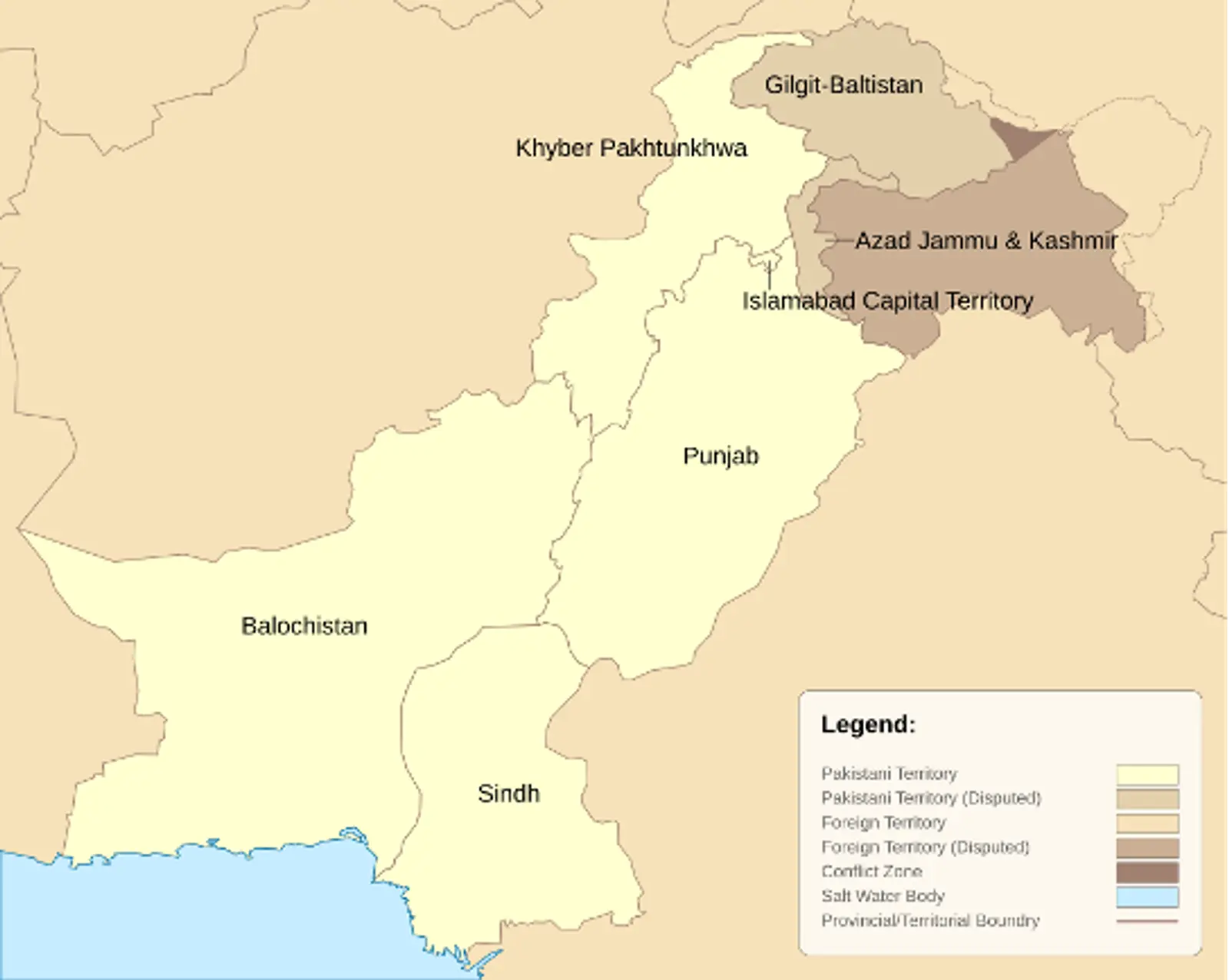
Figure 1: Map of contemporary Pakistan, which constituted West Pakistan in 1947. (Public domain)
These performances emerge from deeply rooted cosmologies and regional epistemologies, where spiritual recitation enacts memory, devotion, and belonging. Centering these perspectives reveals that sung Sufi poetry is not as a generic musical genre, but a cultural and ideological practice shaped by local communities as they negotiate a national Muslim identity within postcolonial nationhood (Hemani 2019).
Qawwālī and the Formation of National Culture in Pakistan
The popularization of Sufi qawwālī began in the late 19th century with the advent of gramophone recordings (Qureshi 2008), which facilitated its circulation beyond the sacred shrines and into the urban soundscapes of colonial Indian cities under British rule. Qawwālī was the most popular of religious music that was recorded in colonial India and led to a genre called “Muslim Devotional” within the record industry (Qureshi 1993, 111).
Rendered in their own language and imbued with the sacred and poetic legacy of Sufi saints, the lyrical content of qawwālī resonated deeply as a form of Muslim cultural belonging (Qureshi 1993, 111-121) that had been impacted by the 1867 Hindi–Urdu controversy (Jalal 1990, 128)—a debate that continued to define Muslim communal identity in both colonial India and the postcolonial states of India and Pakistan.
Even as qawwālī remained firmly embedded in Sufi devotional practice, it was widely recorded and disseminated through mass media—from loudspeakers at shrines to radios, televisions, and cassette players—thus transforming it into a genre that transcended the sacred and entered public, often urban, spaces (Qureshi 2008). This process of mediation allowed qawwālī to evolve beyond its local ritual context, making it a vital part of the larger cultural fabric, not only for the communities involved but also for broader audiences as well.
Before the Partition of India in 1947, Muslim elites—primarily Urdu poets and broadcasters selected verses from Urdu poets ranging from Wali Dakni to contemporary poets for radio programs (Ahmad 2005, 60). They also drew on the legacy of figures such as Sufi mystic Amir Khusrau, whose contributions shaped the aesthetic and thematic foundations of Muslim musical-poetic expression (Qureshi 1993).
Qawwāli, as part of this sonic transformation, became a central genre in the creation of Pakistan's national sound, and Radio-Pakistan’s programming promoted qawwālī alongside other music genres that were perceived as culturally Muslim, such as ghazals and classical compositions. The genre became a tool for the state to promote a specific narrative of Islamic culture, positioning it as part of the broader project of national identity formation. Over time, qawwālī moved beyond the shrines and found its way into the urban entertainment scene, further entrenching its place in Pakistan's sonic landscape.
Building on Qureshi’s analysis of qawwālī, I offer an original examination of Aziz Mian, an Urdu-language performer whose national prominence emerged through Radio Pakistan and Pakistan Television’s programming and media infrastructures. Aziz Mian Qawwal’s (1942–2000) rendition of qawwālī was raw, passionate, and confrontational. He shouted rather than sang, pushing the limits of the genre’s emotional and vocal intensity. His delivery was full of fervor, repetition, and argument, often resembling a dialogue with God or the audience. He would question divine justice, human hypocrisy, and spiritual longing in a way that was at once devotional and defiant—for instance, in his famous qawwālī “Main Sharābī” (“I am a Drunkard”), he used intoxication as a metaphor for divine love, turning a socially condemned act into a spiritual allegory.
He also has the record for singing the longest commercially released qawwālī, “Hashr Ke Roz Yeh Poochhungā,” which runs slightly over 115 minutes (ARY News 2016). This reflected how local musicians expanded the expressive and temporal scope of qawwālī, subverting the abbreviated, radio-friendly formats initially promoted in the gramophone.
Video Example 1: “Main kya jānūñ” by Aziz Mian Qawwal (Author’s transliteration, translation, and interpretation below).
Listen to Example 1, an excerpt of an important qawwālī “Main kya jānūñ, mujhe kya mālūm, maine to yeh sochā hai ke tū hai to main hoon,” which translates as “What do I know? What could I ever understand? I only know that because You exist, I exist.” This refrain encapsulates Aziz Mian’s mystical humility before the Divine: the recognition that the self (main) has no independent reality outside of the Beloved (tū).
In performance, Aziz Mian builds the energy through relentless questioning of Allah’s existence:
Ay Allāh, tū Lā Patā hai.
Aur lā patā kā ḍhoonḍhnā be-sūd hai.
Par kyā karū main, Lā Patā to har jagah maujūd hai.
Ay Allāh, terā har shai se miltā hai patā,
lekin tū khud hai lā patā.
Us Lā Patā kā jab main ḍhoonḍhne niklā patā,
Arey main ḍhoonḍhne niklā patā,
kehtā phirā: “Lā Patā.”
And to search for the Untraceable is futile.
But what can I do—You, the Untraceable, are present everywhere.
O Allah, from everything I find a trace of You,
Yet, You Yourself remain untraceable.
When I set out to search for the Untraceable, I found a trace;
I went seeking a trace and went on proclaiming: Lā Patā!
Aziz Mian addresses the audience at 1:25 in the example above: “Lā aur patā ke darmiyān mein patā batlā rahā hoon.” Between Lā (negation) and patā (knowing) I reveal His trace.
Us Lā Patā kā jab main ḍhoonḍhne niklā patā,
Arey main ḍhoonḍhne niklā patā,
Lā Patā, Lā Patā, Lā Patā !
Lā Patā kehte kehte khud ho gayā main Lā Patā.
[refrain] main kyā jānūñ, main kyā jānūñ, Arey main kyā jānūñ
When I set out to seek the Untraceable,
When I set out to seek His trace;
Lā Patā! Lā Patā! Lā Patā!
And in calling out Lā Patā again and again,
I myself became untraceable.
What do I know, what do I know, oh, what do I know…
The qawwālī begins with a meditation on the Urdu word, lāpatā. Lā (in Arabic/Urdu) means negation—“not,” “no,” or “non-existence,” and patā (in Urdu) means “address,” “trace,” or “knowledge/awareness” (“to know,” “to locate”). Here, Aziz Mian is engaged in a recitative style of bayān, which literally means “exposition,” “interpretation,” or “expression.” It is the spoken or semi-spoken part of a qawwālī performance where the lead qawwāl pauses from melodic singing to explain the poetry, interpret the metaphors, and move the audience emotionally and spiritually. So when Aziz Mian sang, “Ay Allāh, tū Lā Patā hai,” he’s calling God both “unknowable” and “everywhere traceable”—a paradox that only becomes meaningful through the distance between lā (nothingness) and patā (knowing/being found). Aziz Mian boldly repeats the whole invocation, letting the audience know that he is repeating it because he wants to make this exposition clear, and only within its clarity does the refrain “mein kyā jānūñ” become meaningful and explicit. By repeating the phrase, Aziz Mian guides the audience to meditate on that distance—the very space where the seeker (dervish) finds the Divine. It becomes a kind of zikr (remembrance) through contradiction.
Iconic figures like the Sabri Brothers and Aziz Mian played a central role in popularizing qawwālī both nationally and internationally. Their distinctive styles, rich repertoire, and charismatic delivery preserved the devotional core of the genre while making it accessible to urban middle-class audiences. According to Quereshi, the Sabri Brothers, led by Ghulam Farid Sabri and Maqbool Ahmed Sabri, were the founders of a new form of qawwālī rendition that took traditional long-form qawwālī performed at the shrines with a stirring tablā beat, textual articulation, and improvisational form. In these broadcast contexts, qawwāls began incorporating elements of Hindustani art music into their performances (Qureshi 1993, 118), a trajectory that reached new expressive and technical heights in the work of Nusrat Fateh Ali Khan. These innovations in singing qawwālī also reflect a departure from the qawwālī rendition at the shrine which is strictly regulated by the presence of the sajjādā nashin (spiritual authority) who identifies which texts are permissible to be sung within the spiritual settings of the shrine as well as manners of performance (for more details see Qureshi 1986 and Qureshi 2000a and 2000b)
These innovations in qawwālī renditions in the founding years that Qureshi refers to as a “serious popular religious qawwālī” departed from the short-form, entertaining qawwālī that were popular on films and gramophone records (1993, 118). In comparison to popular forms, they offered a musical experience to the listener which could be serious and spiritual as well as entertaining. This trajectory should not be read as a return to an earlier “purely devotional” form of qawwālī, but as a reconfiguration of listening produced by shifts in media technology. As Qureshi (1993, 2008) demonstrates, the gramophone and early radio compressed qawwālī into short, entertainment-oriented formats, while later media such as cassette, television, and LPs re-extended performance time, allowing the affective intensity of long-form qawwālī to circulate within mass mediation. What emerged was not a simple revival, but a hybrid mode in which spiritual absorption and popular appeal coexisted in mediated space.
Video Example 2: “Tajdār-e-Haram” by The Sabri Brothers (Author’s transliteration, translation, and interpretation below): The Sabri Brothers were led by Ghulam Farid Sabri (b. 1930 in East Punjab–d.1994 in Karachi, Sindh) and his brother Maqbool Ahmed Sabri (b. 1945 in East Punjab–d. 2011). They are often referred to as “Shahenshah-e-Qawwālī” (the King of Kings of qawwālī), reflecting their significance in the national repertoire of qawwālī from Pakistan.
This is well exemplified in Example 2, “Tajdar-e-Haram,” with its characteristic refrain in Rāg Bhairavi:
Nigāh-e-karam, tajdār-e-haram
Hum garibon ke din bin sanwar jayein ge
O Lord of the Kaba, bestow your benign glance on us,
So that the lives of us, the poor, may be enriched
Urdu, as the national lingua franca, was key to unifying diverse linguistic communities through the broadcast of qawwālī, shaping a shared sonic identity in the newly formed state. Additionally, elements like extended introductions and musical improvisations—hallmarks of qawwālī performances—were adapted for national broadcasts but retained the goal of evoking spiritual absorption (ḥāl) (Qureshi 1999a). In Pakistan, another evolving trend in qawwālī performance was the incorporation of Arabic phrases—for example, in Manzur Niazi’s “Allāh Allāh Allāhu” (Qureshi 1993, 119).
While qawwālī became increasingly central to Pakistan’s national cultural narrative, its institutionalization through Urdu contributed to the marginalization of other Sufi musical and poetic traditions in regional languages—most notably Sindhi kāfī, which developed around Hyderabad (Hemani 2019). Yet this process was not absolute: qawwālī itself has deep multilingual roots, and Punjabi kāfī—drawing on poets such as Bulleh Shah—continued to circulate beyond the state’s broadcast system (Hemani 2011). It is telling that many of the qawwāls who came to define “national” qawwālī—such as the Sabri Brothers—were Punjabi speakers, yet performed almost exclusively in Urdu on Radio Pakistan, which positioned Urdu as the legitimate sonic register of Muslim national culture. A related, but beyond-the-scope question concerns the later re-emergence of Punjabi Sufi poetry in mediated contexts—an evolution that signals a different trajectory of regional expression outside the Urdu-national frame. This trajectory can be traced, for example, in the increasing prominence of Punjabi kāfī in Nusrat Fateh Ali Khan’s later repertoire.
Notes
Popular accounts, such as Patrick’s award-winning 2015 biography of Nusrat (Nusrat Fateh Ali Khan: Le Messager du Qawwāli), by contrast, foreground his formation in post-Partition Pakistan. While insightful, such works fall outside scholarly ethnomusicology and have not substantially shaped its discourses.
The study draws on policy documents and archival materials related to national broadcasting reforms and cultural programming (including Ministry of Information reports and interviews with media administrators), alongside perspectives from key policy elites involved in shaping cultural policy during the postcolonial period. These elites include, but are not limited to, Qudratullah Shahab, Faiz Ahmed Faiz, Naeem Tahir, and Uxi Mufti—among others—who were appointed by heads of state, including presidents and prime ministers of their times, to establish national cultural institutions such as the Pakistan National Council of the Arts, Lok Virsa, and the PIA Arts Academy (see Hemani 2011 for a detailed list).
For details on the archival sources and interviews with policy elites and broadcasters, see Hemani (2011; 2019).
While scholarship on musical nationalism in Pakistan remains relatively limited, a number of studies have addressed related themes and debates. Qureshi (2002) has briefly touched on this topic in an encyclopedia article, but Hemani (2011)—written under her mentorship—expands on these earlier observations by identifying key policy actors, their contributions, and the broader politics shaping musical nationalism in Pakistan. This chapter builds on that body of work while situating Pakistan’s experience within wider global discussions of music and nationalism.
For further discussion on the debates surrounding the categorization of Sufi traditions, see Hemani (2016, 2019), which examines the discourse between N. A. Baloch and other scholars from India on whether Shah Abdul Latif Bhitai’s tradition should be classified within “folk traditions” (laukika vinoda).
This chapter has multiple parts
Go toShumaila Hemani, Ph.D.
Dr. Shumaila Hemani is an ethnomusicologist, soundscape composer, and former Music Faculty for Semester at Sea (Spring 2020) and Music and Communications Instructor at the University of Alberta. She holds a PhD in Music (2019) and an MA in Ethnomusicology (2011), studying under Professor Regula Burckhardt Qureshi. Her work has appeared in the Encyclopedia of Women and Islamic Cultures (2016), Brainfood (2023), The Conversation (2020), Journal of Environment, Arts, and Culture (2022), and other venues. A first-prize recipient from the Society for Ethnomusicology (2017), she was nominated for the Banting Postdoctoral Fellowship at Memorial University (2024) and consulted on Musical Workshop’s South Asia module. Her forthcoming monograph is under contract with Routledge.
